Last updated November 18, 2026



Free written scope consultation - allowances, timeline, and change-order rules on paper before a single trade is scheduled
Driveway & Pavers Maintenance Checklist for Plano Homeowners
Plano’s expansive clay soil moves as much as three inches vertically between wet and dry seasons – more than almost any other soil type in the country – and that movement is what splits pavers and heaves concrete slabs, not the summer heat everyone blames. Walk most Plano driveways and the cracks you see didn’t come from bad materials. They came from a skipped fall inspection, a joint that lost its sand, or a low spot that held water through one wet spring too many. This checklist walks you through the exact seasonal schedule and warning signs to watch, so a $400 repair stays a $400 repair instead of turning into a four-figure replacement.
Quick Answer
In Plano, driveway pavers need inspection twice a year – once in spring when clay is saturated and heaving, once in fall when it’s drying out and shrinking – plus joint sand top-offs whenever you see gaps and resealing roughly every three to five years depending on UV exposure. The two signals that come before nearly every premature failure are edge creep and joint sand loss, and both are cheap to fix early.
Styles & brands we work with
- Kitchen remodeling
- Bathroom remodeling
- Home additions & ADU
- Roofing
- Windows & doors
- Driveway & pavers
- Fence
Table of Contents
- Why Plano’s Clay Soil Drives Pavement Failure
- The Seasonal Inspection Checklist for Plano
- Identifying Edge Creep and Joint Sand Loss Early
- Sealing Schedule for North Texas UV Exposure
- How Drainage Grading Interacts With Paver Longevity
- What You Can Do Yourself vs. What Needs a Pro
- Common Mistakes to Avoid
- Frequently Asked Questions
Why Plano’s Clay Soil Drives Pavement Failure
Most of Plano sits on what soil engineers call highly expansive clay. It’s the same blackland-type soil that runs across much of the North Texas prairie, and it behaves nothing like the sandy or gravelly soils you’ll find in parts of the Hill Country or East Texas. When it gets wet, it swells. When it dries, it shrinks and pulls away from anything sitting on it. That cycle happens every year, and on a driveway the movement concentrates at the edges and along joints, which is exactly where failures begin.
What makes Plano harder on pavement than most of the country:
- Big wet-dry swings. A wet spring can drop twelve or more inches of rain, then a stetch of dry, 100-degree weeks shrinks that soil back by inches. Concrete and pavers don’t flex. Something has to give.
- Relatively flat lots. Plano’s terrain is gentle, which means water drains slowly and often sits. Where the ground can’t slope away fast, water finds the low spots in your driveway instead.
- Summer UV load. North Texas summer sun is brutal on sealers and polymeric joint sand. Products that last five years in Ohio are doing well to reach three or four here.
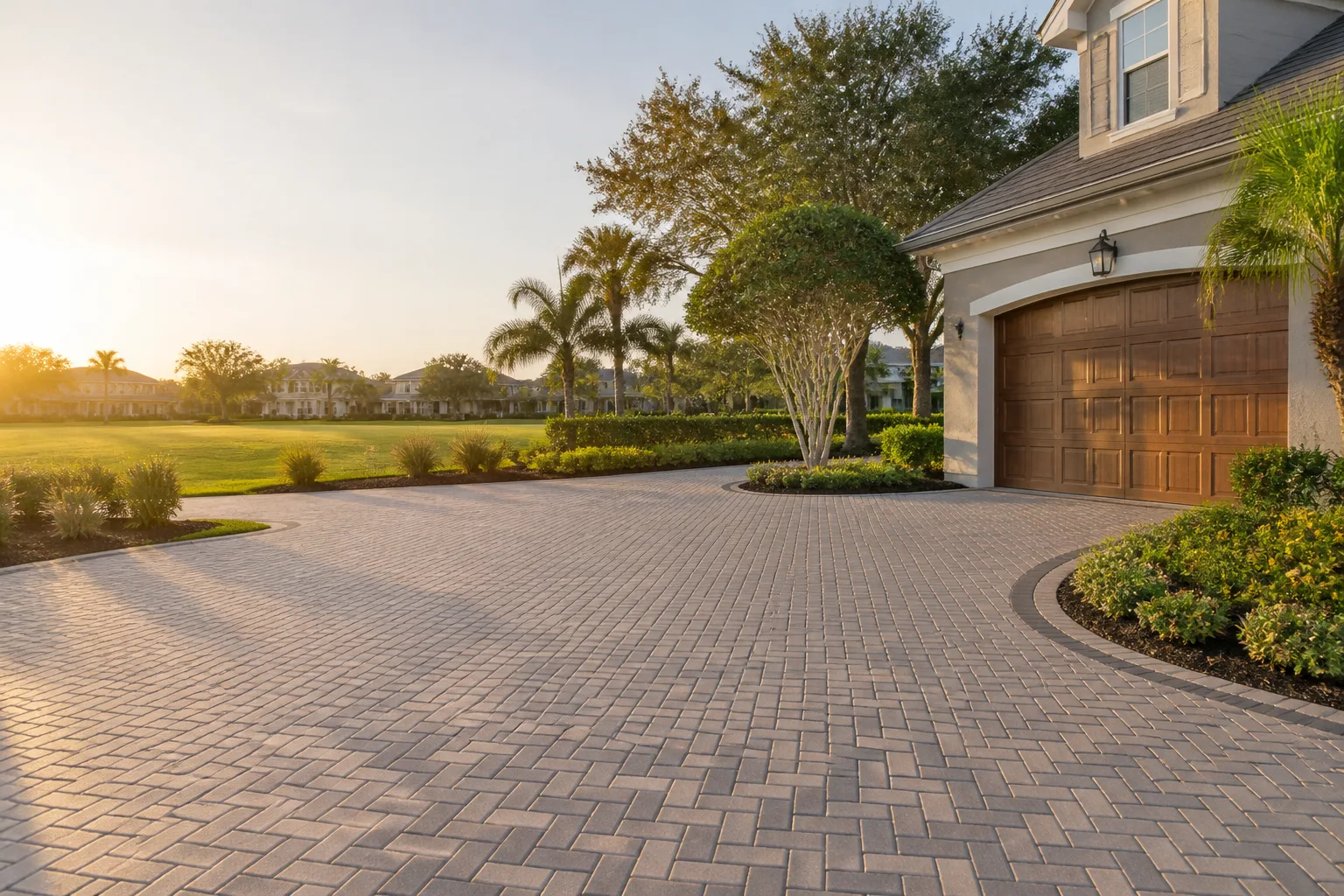
Understanding this is why maintenance here isn’t the same generic advice you’ll find from national sites. Moving into construction? Moving dirt too close to a slab? It matters. When you see Driveway & Pavers in Plano done right, you’re seeing three things: proper base prep, correct grading, and a homeowner who knew when to call.
The Seasonal Inspection Checklist for Plano
Timing inspections to Plano’s wet and dry cycles is the highest-value maintenance habit you can build. Here’s the cycle we’ve watched fail and succeed on driveways all over Plano, and what each season demands.
- Spring (March-May): watch for saturation and heaving. This is when clay is at its wettest and most swollen, and when heaved panels and shifted pavers show up. Walk the driveway after heavy rain and mark any low spots that hold water. Photograph them; water marks a problem a dry walk won’t.
- Midsummer (June-August): watch for shrinkage cracks and joint sand loss. As clay dries and shrinks, gaps open and joint sand washes or blows out. Sweep a few joints with your fingers; if sand sits below an inch from the paver surface, it needs topping off before fall.
- Fall (September-November): the big recharge inspection. This is the one to take seriously. After the first good soaking rains, recheck edges, joints, and drainage. Fill joints, reset any rocking pavers, and schedule sealing if it’s due. Fall is the best seal window in Plano because you want moderate temperatures and no hard freeze risk.
- Winter (December-February): a light once-over. Clay is usually stable in cooler months, so this is a quick check for any pavers that moved during fall rains and to clear leaf debris from drainage paths before the next wet season.
Write the dates down. A phone photo of the same corner every season makes early movement obvious in a way memory won’t. That record is exactly what a professional needs if something does go wrong.
Identifying Edge Creep and Joint Sand Loss Early
If you learn two signals, learn these. In our experience, edge creep and joint sand loss come before roughly 90% of paver failures we inspect. Both are cheap to catch early and expensive to ignore.
Edge creep
Edge creep is when the pavers along the driveway’s perimeter slowly push outward, opening a gap between the pavers and the edge restraint or the lawn. It starts as a hairline gap. Left alone through a couple of wet-dry cycles, it widens, lets soil and water in, and the whole edge loosens.
How to check:
- Kneel at each corner and look down the line of the outermost pavers. A straight, tight line means the restraint is holding.
- Look for a visible gap of a quarter-inch or more between the edge paver and the restraint or concrete edge.
- Press down on edge pavers with a hand. Any rock or settle at the edge is a sign the base under it has washed out.
Joint sand loss
Joint sand is what locks each paver in place. It’s not decorative. When it washes or blows out, pavers start to shift and chip at the chamfered edges. Check depth by pushing a screwdriver or a finger down a joint in early spring and late summer. If the joint is more than about an inch below the surface, it’s time to refill.
Fixing joint sand is rarely a DIY job that lasts. The sand needs to be the right graded type, swept in, and vibrated into place with proper compaction, and it needs to sit on a stable base. In our experience, a homeowner refills sand and it’s gone by the next spring unless the grading above it is corrected first – which is why we’re cautious about promising a quick fix without looking at drainage.
Sealing Schedule for North Texas UV Exposure
Here’s where national advice usually gets it wrong for Plano. Sealing schedules you’ll read online are built for cooler, cloudier climates. North Texas is not that place.
In our experience, a quality penetrating sealer on a Plano paver driveway holds up best when it’s reapplied every three to four years, and a surface film-forming sealer may need attention every two to three. Several factors push the interval shorter:
- UV intensity. North Texas sun degrades film build and dries out penetrating sealers faster than anywhere in the Midwest.
- South- and west-facing driveways. A driveway facing the afternoon sun in Plano takes a beating no north-facing driveway gets.
- Vehicle traffic. The tire-track zones are the first to fail on any sealer.
Two product categories matter. Penetrating sealers soak into the paver and lock out moisture without changing the look – best for natural stone and most pavers, and best at resisting clay movement because they let the material breathe. Film-forming sealers sit on top and add a wet-gloss finish, but they wear faster in UV and can pool water if the surface is too smooth.
Sealing is a mid-to-late fall job in Plano. You want moderate temperatures, low humidity, and no rain in the forecast for at least 24 hours. Catching it on a dry fall weekend matters more than any single brand choice.
How Drainage Grading Interacts With Paver Longevity
Plano’s relatively flat lots mean drainage has less room to be casual. Water doesn’t rush anywhere; it has to be guided. A pavers will look beautiful on day one and start failing within two years if the slab or paver base isn’t pitched away from the home correctly.
The rule that protects the house first, then the driveway:
- Pitch away from the foundation. The driveway base should slope a minimum of two percent away from the garage slab, which is roughly a quarter-inch per foot. A paver driveway installed dead level will hold water against the yard, right at the edge where clay movement is worst.
- Give water a route off the property. On a flat lot, that often means a shallow swale or a French drain at the low edge. Without it, water ponds at the driveway’s edge and softens the base.
- Keep the base compacted and dry through installation. That’s a contractor’s job and one of the reasons a poorly built paver driveway can fail even if everything looks right on the surface.
If you add a driveway extension or a paver patio near the home, that “relatively flat” grade has to be planned. We see it all the time with Home Additions & ADU in Plano – a project that changes how water reaches the driveway and, unless the grade is reworked, quietly undermines the pavers in a wet season. A quality contractor walks the grade before the first paver is set.
What You Can Do Yourself vs. What Needs a Pro
Plano homeowners can absolutely protect their investment with routine maintenance. Here’s the honest split.
Keep in the DIY lane:
- Seasonal visual inspections and photo records.
- Cleaning the surface with a push broom or leaf blower. Avoid pressure-washing at high pressure; it blows out joint sand.
- Pulling weeds in joints by hand or with a hook tool.
- Clearing leaves and debris from swales and drains.
- Small spot applications of the correct joint sand on isolated joints, following the paver manufacture’s directions.
Needs a licensed contractor:
- Replacing or repairing the edge restraint or resetting edge pavers – this requires lifting pavers and rebuilding base, which is where material warranties live.
- Fixing any regular settling or heaving larger than a small spot. That points to a base or drainage problem underneath.
- Full joint sand reinstall with compaction.
- Applying sealer on a large driveway, or any surface with drainage concerns.
- Drainage corrections and re-grading.
One warning specific to pavers: improper repair can void the paver manufacturer’s warranty. If your driveway was built with a premium line like Belgard or Techo-Bloc, or the base was specified under a named material warranty, a self-installed patch with the wrong base or edge restraint can put that coverage at risk. Ask before you touch it, and get the answer in writing. That’s the same principle we hold to on every job: scope in writing, allowances in writing, change orders in writing.
Fence lines, gates, and property edges often sit right where a driveway meets the yard, so drainage often intersects with Fence Installation in Plano too – a gate post set too close to a paver edge can trap water against the driveway.
Common Mistakes to Avoid
- Blaming the heat instead of the clay. Plano’s summer heat gets attention, but it’s the wet-dry clay movement and poor drainage that actually break down pavement. Fix the water, and the heat stops being the problem.
- Skipping the fall post-rain inspection. The single best window to catch movement in Plano is right after the first good fall rains, not in July. Miss it and you find the problem in spring when the clay is already heaving.
- Pressure-washing the joints out. A high-pressure nozzle blasts joint sand loose in minutes and starts the shift cascade. Clean with a broom, not a jet.
- Trying to seal before fixing grading. Sealing over a spot that holds water traps moisture against the base. Correct the grade first, then seal.
- Ignoring edge creep because it’s small. A quarter-inch gap at a Plano driveway edge seems harmless. Two wet-dry cycles later it’s a loosened edge with a washed-out base under it.
- Patching a big settle with a little sand. Sand hides a settled paver for a season and returns the next. It’s a sign of a base issue a pro needs to see.
- Letting a contractor quote one price and bill another. Ask for line-item, written pricing up front, and require a written change order for anything that shifts. An allowance that isn’t on paper is a surprise waiting for a date.
See the difference
 Before
 After
 Before
 After
 Before
 After
When to Call a Professional
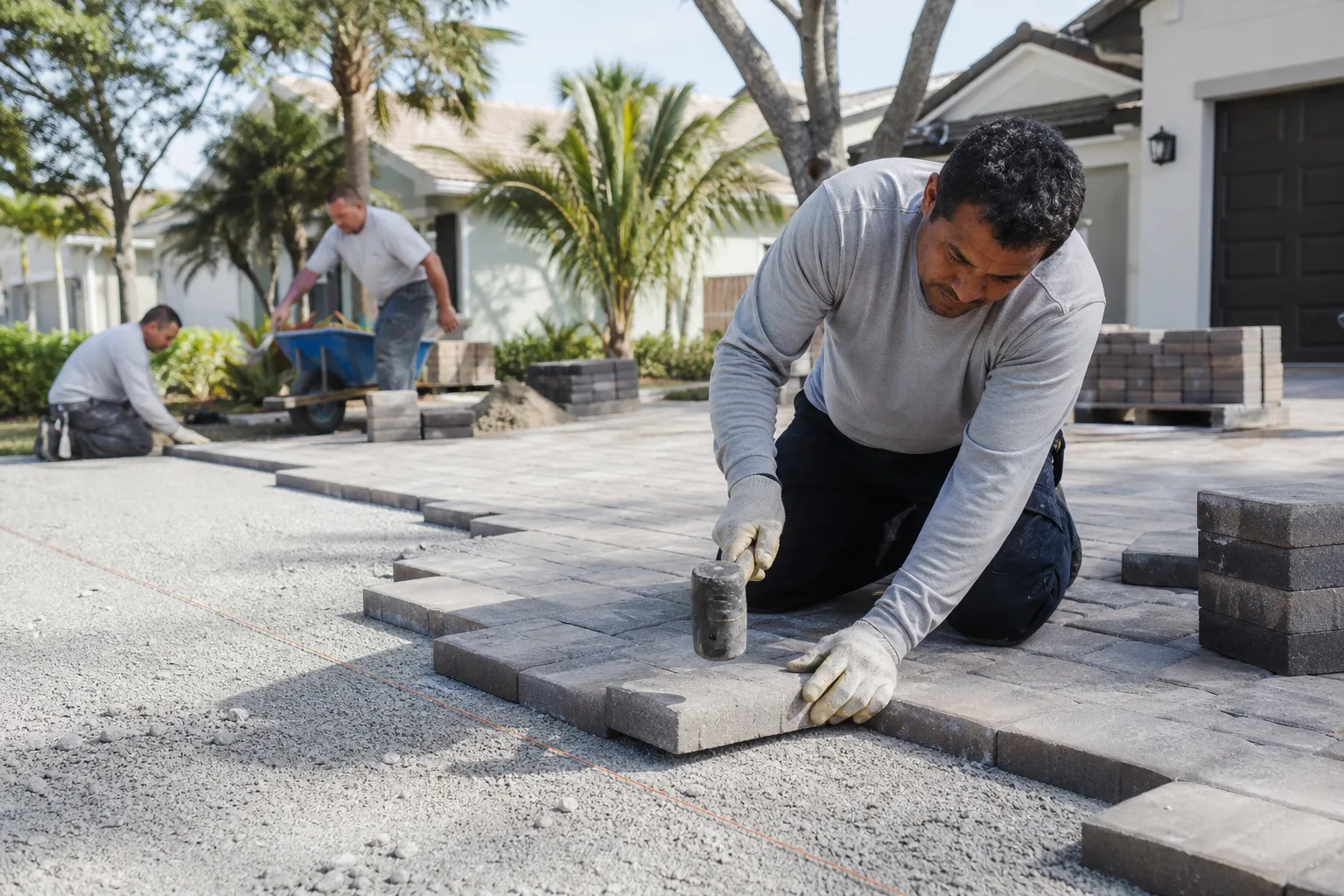
Call a licensed contractor when you see any of the following: a paver or edge section that rocks when you step on it, a gap at the edge restraint wider than a quarter-inch, a low spot that holds water more than a day after rain, joints that won’t hold sand through a season, cracks that reappear in the same place after patching, or any settlement you can see from your front porch. These are signs the base or grading needs a real fix – not more sand. Plano homeowners also need a pro before touching anything that risks a material warranty, and before any drainage work near a foundation. The permit and inspection process exists to protect you; a permit inspector works for you, not the contractor. Barrett & Sons Construction Plano offers free estimates in Plano – call (877) 382-4108. Our team has up to 28 years of experience, and every eligible job gets permits pulled and a written 90-Day Done Right Promise.
Frequently Asked Questions
Plan on resealing every three to four years with a penetrating sealer in Plano, and every two to three years for a film-forming gloss sealer on a sun-exposed driveway. The stronger UV here burns through sealers faster than in cooler climates. If water stops beading on the surface, it’s due. Call (877) 382-4108 for a free evaluation of your driveway.
Clay swelling is the cause. When spring rains saturate the expansive clay under a driveway, it lifts the base and pushes pavers up at the joints or edges. Heaving is a base and drainage signal, not a paver failure. Get a professional look before the next rainy season rather than patching over it.
You can, but keep it gentle. Use low pressure and a wide fan tip, and never aim straight down into the joints, which washes out the sand that locks pavers together. For anything beyond surface cleaning, a contractor is the safer call.
It can. Many premium paver warranties, including those on Belgard and Techo-Bloc installs, require proper base preparation and edge restraint, and a self-installed patch with the wrong materials can put coverage at risk. Ask the manufacturer or your installer before you pull up any paver. Call (877) 382-4108 with questions free of charge.
Often yes, especially when the work touches the right-of-way, a drainage path, or a structural slab. The rules vary by project and location. A licensed contractor should confirm and pull the permit rather than leaving it to you. On our jobs, permits are pulled and inspections signed on every eligible job.
A properly installed, well-drained, and maintained paver driveway can hold up for decades in this climate. The key variables are base prep, correct grading, and staying ahead of joint sand and edge movement. Let a problem slide too long, and you can shorten that life dramatically.
Barrett & Sons Construction Plano home is where you can look up the details before you call – the name, the address, and the license number are all published.
The Bottom Line
Plano driveways don’t fail from bad materials. They fail because the expansive clay, the flat lots, and the summer sun were never factored into a maintenance schedule. Inspect twice a year – spring for saturation, fall for the recharge – and catch edge creep and joint sand loss before they become rebuilds. Seal on a North Texas schedule, not a cooler-climate one, and respect the grade. Most of what you save comes from catching failure early and knowing which repairs need a licensed pro. If something looks wrong, get a second set of eyes on it before you spend a dime on sand.
Barrett & Sons Construction Plano has been owner-operated since 1998, with crew members who carry the Barrett & Sons name on every visit. Call (877) 382-4108 for a free estimate, and ask about our published standing offers – $40 off any repair over $200, a free second opinion on any written estimate, no trip charge inside the county, and a permanent 10% Senior & Veteran discount. A live person answers, day or night, and if we ever have to come back and make something right, the 90-Day Done Right Promise is written on the contract, not buried.
Written by the team at Barrett & Sons Construction Plano.